
September 30, 2025/
Basic strategy alone cannot beat the house edge in blackjack. The only way to shift the odds is through betting...
Earlier experiments showed how an RL agent can learn basic strategy, adapt to real casino rules, and rediscover card counting by scaling bets with deck composition. This final step uses a neural network to approximate Q-values, enabling generalization across a much larger state/action space and combining both betting and play decisions.
The environment provides a fixed-length numeric observation vector that encodes both phases and the count:
def _obs_vector(self):
    """
    Return a fixed-size numeric vector for DQN:
     [phase_play,               # 1 if play-phase, 0 if bet-phase
      player_total_norm,        # /21 (0 if bet phase)
      dealer_up_norm,           # /10 (0 if bet phase)
      usable_ace,               # 0/1
      allow_double,             # 0/1
      true_count_bucket_norm,   # bucket / max(|min|,|max|)
      bet_norm]                 # current bet / max(BET_OPTIONS)
"""This lets the network reason jointly about play context, dealer strength, doubling eligibility, and the true count signal driving bet sizing.
The network outputs Q-values for all actions (bet actions during the bet phase; hit/stand/double during play). Not all actions are legal in every state, so the TD target masks invalid actions:
def compute_td_target(q_next, mask_next, rewards, dones):
    """
    q_next: [B, A], mask_next: [B, A]
    target = r + gamma * max_a' q_next(s', a' allowed) * (1-done)
    """
    # set invalid actions to -inf so max ignores them
    q_next_masked = q_next.clone()
    q_next_masked[mask_next == 0] = -1e9
    max_next, _ = q_next_masked.max(dim=1)
return rewards + (1.0 - dones) * GAMMA * max_nextThis preserves blackjack rules (e.g., Double only when allowed) while stabilizing learning with a target network, replay buffer, and ε-greedy exploration.
Below is the exact training log snapshot from a 150k-episode run:
Ep   5000 | EV -0.0068 | W/P/L 0.438/0.092/0.470 | ε=0.193
Ep  10000 | EV -0.0427 | W/P/L 0.429/0.081/0.490 | ε=0.187
...
Ep 145000 | EV -0.0035 | W/P/L 0.434/0.091/0.475 | ε=0.020
Ep 150000 | EV -0.0333 | W/P/L 0.422/0.086/0.491 | ε=0.020Observations:
To better understand stability, two curves are tracked during training:
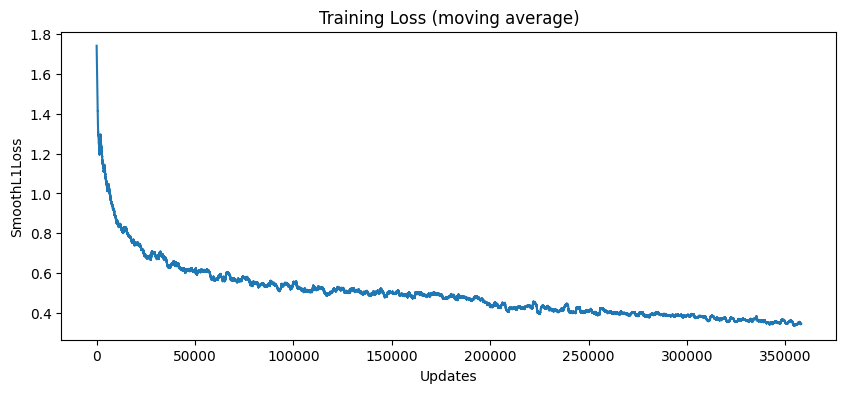
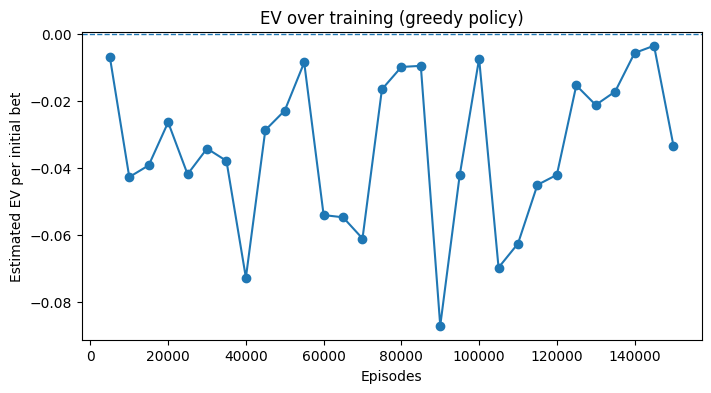
Typical runs show high loss variance in the first 20k episodes, then a downward trend. EV estimates follow a noisy trajectory but settle in the −0.01 to −0.05 range, consistent with professional-level play but still negative given house rules.
First-decision tables display human-like structure: