January 19, 2026/
As part of a larger NLP project focused on analyzing shareholder communications, I needed a clean, consistent corpus of historical...
Building a practical workflow for the Ross Automated Solutions website, one unpublished draft at a time.
My website is a portfolio, a record of projects, and a resource for prospective clients. Keeping it useful takes more than writing. Each article needs a clear structure, readable formatting, and a presentation that works within the site.
Like many small-business owners, I fit that work around client projects and development. Sharing a finished project can feel like starting another one, especially when the same formatting and checking tasks come around again.
Much of my work involves making processes easier to repeat. I wanted to apply that thinking to my own website: reduce routine effort, keep decisions visible, and retain control over what becomes public.
The question behind this experiment was practical: could AI assistance help me move from an idea to a useful WordPress draft, with enough checks and human review to make the process worth repeating?
I’m using ChatGPT and Codex for complementary parts of the work. ChatGPT helps me explore ideas, organize the narrative, and clarify what I want the article to say. Codex handles the technical preparation, formatting, tests, and transfer of approved content.
My role remains central. I approve the text, review the actual WordPress page, request refinements, and decide whether to publish. Those decisions are part of the workflow, rather than something to automate away.
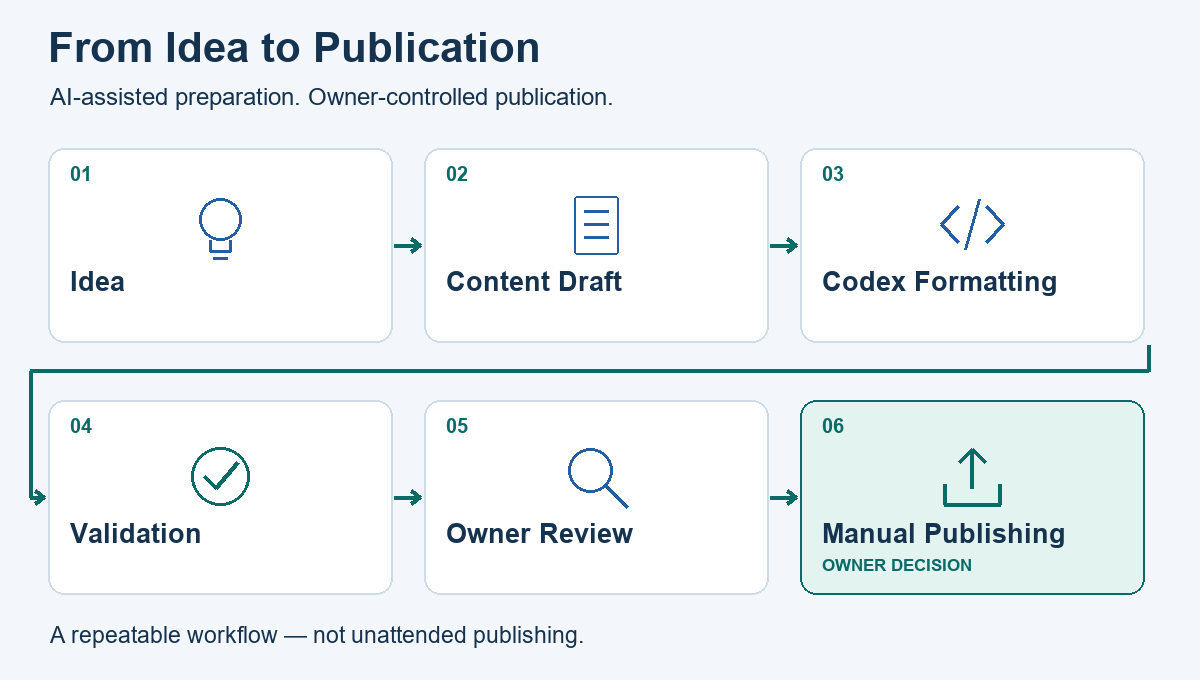
The sequence is idea, content draft, Codex formatting, validation, owner review, and manual publishing.
I run this process on demand using my existing ChatGPT subscription. It does not require separate OpenAI API calls or a background agent continually working on the website.
The site uses WordPress with Elementor and WooCommerce. A small helper converts the article into standard WordPress blocks and transfers approved content through WordPress’s REST API. The aim is to work within the existing site, without rebuilding its templates for each article.
The first live test successfully created an unpublished WordPress draft. Afterward, the helper retrieved it and checked the saved content against the approved source, along with its title, author, and draft status.
I reviewed that draft and asked for a shorter article, clearer sections, and useful visuals. Multiple content-only updates refined the same draft. Codex generated an original workflow graphic locally, uploaded the PNG directly to WordPress, verified its file and media details, and inserted it into the article. My desktop review confirmed that the graphic displays correctly.
That is meaningful progress, but it is not complete acceptance of the publishing process. Content checks identified only a minor image-tag formatting difference in the latest transfer. Separate checks flagged changes to draft date fields. That date behavior remains unresolved; I am not treating it as harmless.
I deliberately retained an Author account for draft preparation and media uploads. WordPress technically lets Authors publish. Codex’s permanent operating instructions and the helper restrict supported article operations to unpublished drafts, while I personally review and publish. Those controls do not remove the credentials’ publishing powers outside the helper.
Seeing the article in WordPress made the next improvements easier to identify. Accurate transfer does not automatically produce an engaging page. A long shaded list may be technically correct while still needing better pacing or a clearer visual hierarchy.
The accepted workflow graphic replaces the crowded inline sequence, while the results panel separates verified capabilities from review work and pending publication. The typography and general desktop layout are also accepted. None of those decisions suggests that every stage is complete.
This has reinforced a useful distinction: automated checks can compare stored content, while I need to assess whether the article communicates well. Short paragraphs, informative headings, and restrained visuals help readers follow the experiment without needing its troubleshooting history.
This article has not been published. Logged-out privacy checks passed within the previously tested post, preview, and public REST URL scope; they were not repeated after every revision and do not cover every access route. Mobile presentation still needs my acceptance. The uploaded image is publicly accessible even while the article remains a draft.
The site’s SEO indexing problem remains unresolved. It is a separate investigation, and successful draft transfers do not establish that search visibility has improved.
My goal is a dependable website workflow I can use whenever I have something useful to share. This experiment has demonstrated creation, revision, and verification, while keeping publication in my hands.