
June 10, 2026/
secfsn_plus is a canonical financial feature engineering layer built on top of SEC fundamental data. The project takes a wide...
Most financial analysis stops at ratios — revenue growth, margins, ROE. Those are useful, but they don’t tell you how reliable or persistent a company’s performance actually is.
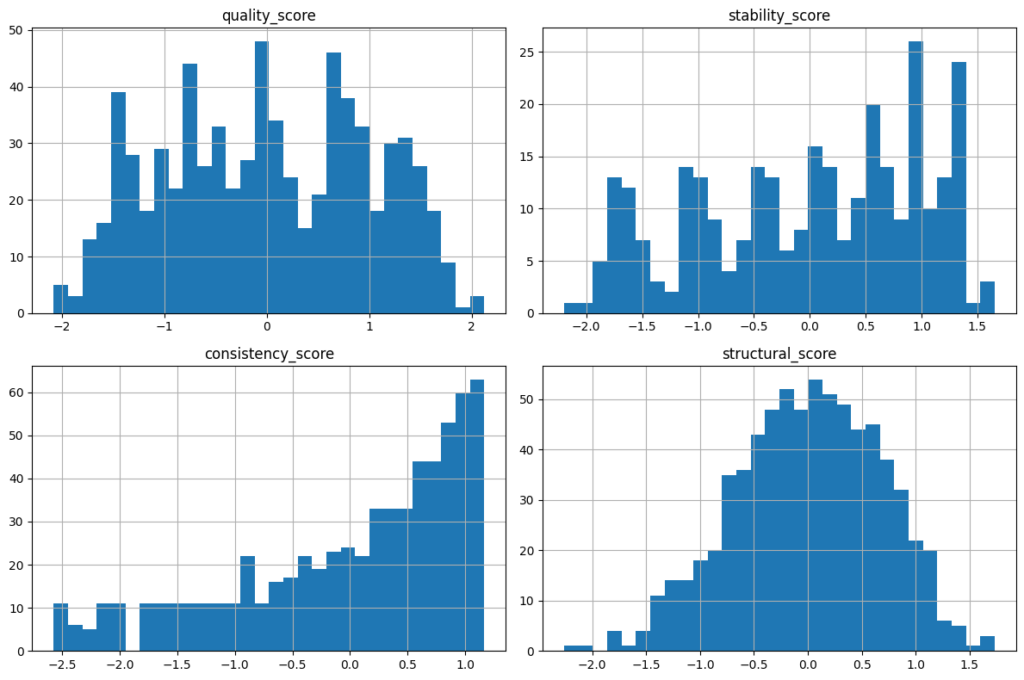
I built a structural feature layer on top of SEC financial data to focus on three things: earnings quality, stability, and consistency over time. Instead of just asking “what are the numbers today?”, the goal is to understand how those numbers behave across periods — whether they’re cash-backed, volatile, or structurally coherent.
At a high level, the system takes cleaned fundamentals and transforms them into a panel of structural signals, along with a composite structural_score that enables cross-sectional comparison between companies.
This project is part of a broader financial data pipeline:
Each layer builds on the previous one, moving from raw data → standardized features → interpretable structural insights.
Two companies can look identical on a snapshot basis but behave very differently over time. This framework helps surface that difference in a systematic and scalable way.
The output is a (company, period) panel of structural features + a scoring layer that can plug into screening, research workflows, or downstream models.
GitHub: Link