
June 10, 2026/
Most financial analysis stops at ratios — revenue growth, margins, ROE. Those are useful, but they don’t tell you how...
Can a Neural Network Learn to Think Like a Calculator?
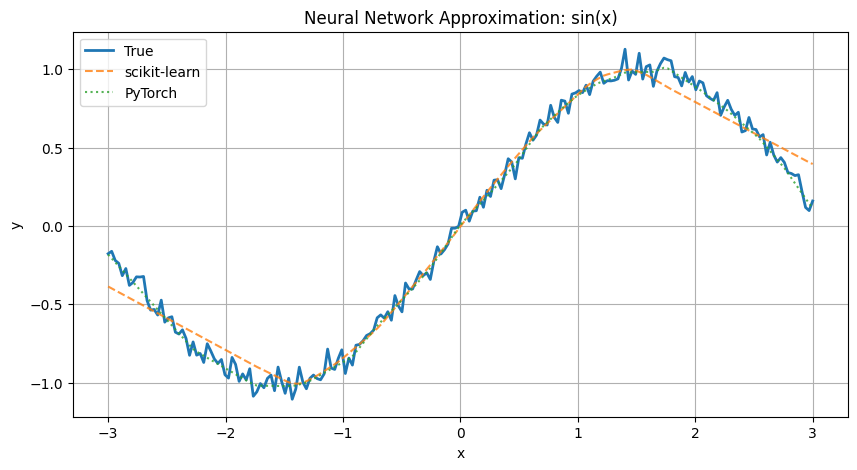
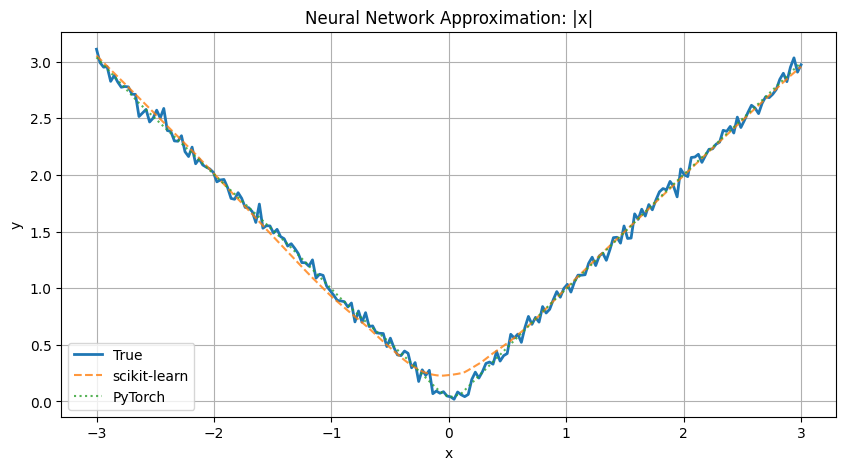
Neural networks have become one of the most powerful and flexible tools in modern machine learning. But how do they actually learn — and can they really approximate things like a calculator? In this first post of our three-part series, we introduce neural networks in a hands-on way by showing how they can approximate simple mathematical functions like:
We’ll use both scikit-learn and PyTorch to compare implementations.
A link to this notebook and the other notebooks can be found here on GitHub
Before using neural networks for pricing complex financial instruments, it’s important to understand what they actually do. These experiments demonstrate a foundational concept:
Neural networks can approximate unknown functions simply by observing input/output examples.
Even when you don’t tell the model the underlying equation, it can figure out the shape of the function by training on data — this is why they’re often called universal function approximators.
We’ll start by creating synthetic datasets using simple mathematical functions. Here’s an example for :
def generate_data(func, x_range=(-2, 2), n_samples=200, noise_std=0.0):
    x = np.linspace(*x_range, n_samples).reshape(-1, 1)
    y = func(x) + np.random.normal(0, noise_std, size=x.shape)
    return x, y

# Define functions
functions = {
    "x^2": lambda x: x**2,
    "sin(x)": lambda x: np.sin(x),
    "|x|": lambda x: np.abs(x)
}
def train_sklearn_model(x, y):
model = MLPRegressor(hidden_layer_sizes=(64, 64), activation='relu', max_iter=5000, random_state=42)
model.fit(x, y.ravel())
y_pred = model.predict(x)
return y_predThe model learns the shape of the function through backpropagation and adjusts its weights to minimize the error.
If you want more control or are preparing for deep learning frameworks, try PyTorch:
class SimpleNN(nn.Module):
    def __init__(self):
        super().__init__()
        self.net = nn.Sequential(
            nn.Linear(1, 64),
            nn.ReLU(),
            nn.Linear(64, 64),
            nn.ReLU(),
            nn.Linear(64, 1)
        )

    def forward(self, x):
        return self.net(x)

def train_torch_model(x, y, epochs=1000, lr=0.01):
    model = SimpleNN()
    criterion = nn.MSELoss()
    optimizer = optim.Adam(model.parameters(), lr=lr)

    x_tensor = torch.tensor(x, dtype=torch.float32)
    y_tensor = torch.tensor(y, dtype=torch.float32)

    for _ in range(epochs):
        optimizer.zero_grad()
        predictions = model(x_tensor)
        loss = criterion(predictions, y_tensor)
        loss.backward()
        optimizer.step()

    with torch.no_grad():
        y_pred = model(x_tensor).numpy()

return y_predYou then train the model using an optimizer (like Adam) and MSE loss.
This allows you to see where the model performs well and where it deviates.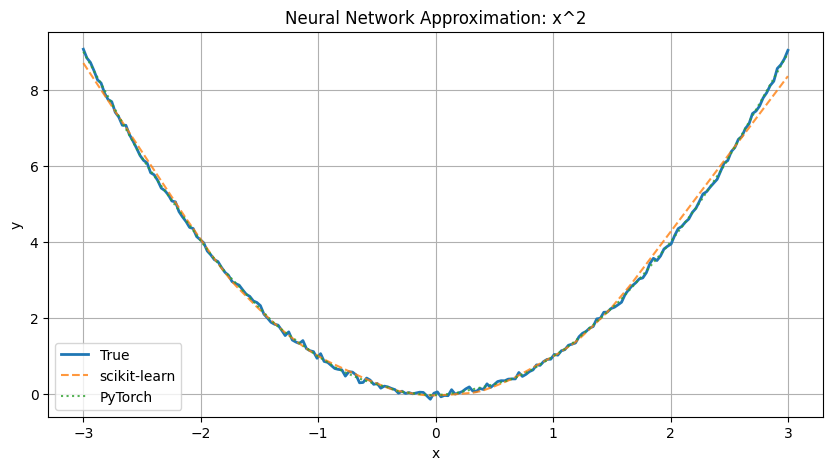
Up next: We’ll show how a neural net can learn to price options. Click here for that post.
A link to this notebook can be found here on GitHub